In this guide:
Get this choice wrong and you'll spend months wishing you'd bought the other one. OLED and QLED are genuinely different — not just in name — and which suits you depends on your room, your habits and what you actually watch. Here's an honest breakdown.
How They Actually Work
OLED (Organic Light-Emitting Diode) — Each pixel produces its own light and can switch itself off entirely. When a pixel is "off," it produces absolute zero light — true black. LG, Sony and Panasonic all use OLED panels (made by LG Display).
QLED (Quantum Light-Emitting Diode) — This is an LED-backlit TV with a quantum dot filter, which converts blue LED light into a much wider range of colours. Samsung developed QLED; Hisense's ULED is a similar technology. The key difference: QLED still uses a traditional backlight.
QD-OLED — A newer hybrid: Samsung combines quantum dots with OLED self-emission. You get the deep blacks of OLED and the brightness advantage of quantum dots. The Samsung S95D uses this technology — and it is genuinely extraordinary.
Picture Quality: Where Each Wins
| Metric | OLED | QLED | QD-OLED |
|---|---|---|---|
| Black levels | ✓✓ Perfect | Good (local dimming) | ✓✓ Perfect |
| Contrast ratio | ✓✓ Infinite | High (not infinite) | ✓✓ Infinite |
| Peak brightness | Good (800–1,500 nits) | ✓✓ Excellent (2,000–4,000 nits) | ✓ Very good (1,500–2,000 nits) |
| Colour accuracy | ✓✓ Excellent | ✓✓ Excellent | ✓✓ Best-in-class |
| Viewing angles | ✓✓ Wide | Average (improves with VA panels) | ✓✓ Wide |
| Motion handling | ✓✓ Excellent | Good | ✓✓ Excellent |
Brightness Matters More Than You Think
If your living room gets a lot of daylight, QLED will serve you better. A Samsung QN90D or Hisense U8N can push 2,000+ nits in HDR highlights — OLED typically peaks at 800–1,500 nits depending on the model. In a bright room, that difference is visible.
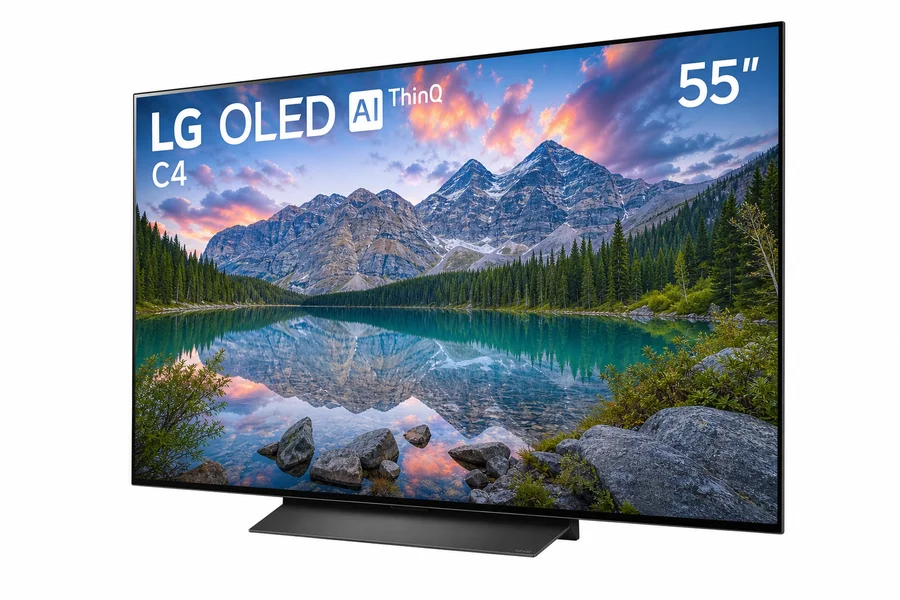
In a dimmer room — evening viewing, controlled lighting — OLED's infinite contrast ratio and perfect blacks create an image depth that no QLED can match. Cinematic content at night on an LG C4 or Sony Bravia 8 is genuinely stunning.
Bright, sunlit room → QLED or Mini-LED. Dark or controlled lighting → OLED. Can't decide? Buy the LG C4 OLED and close the blinds.
For Gaming: OLED Wins Clearly
OLED TVs have near-instantaneous pixel response times (0.1ms) compared to the 2–5ms typical of QLED panels. For fast-paced games, this eliminates motion blur almost entirely. Combined with 120Hz, VRR (Variable Refresh Rate) and HDMI 2.1, a gaming OLED like the LG C4 is the reference choice for PS5 and Xbox Series X.
QLED panels — especially Samsung's Neo QLED range — have improved dramatically and many now hit 120Hz with HDMI 2.1 and excellent VRR support. But side-by-side, the OLED motion clarity advantage remains measurable.
Price and Value in 2026
Prices have converged significantly. A 55" LG C4 OLED currently retails at £999 — which would have been unthinkable three years ago. A comparable 55" Samsung QN90D Neo QLED sits around £1,099. The gap has essentially closed at the mid-range.
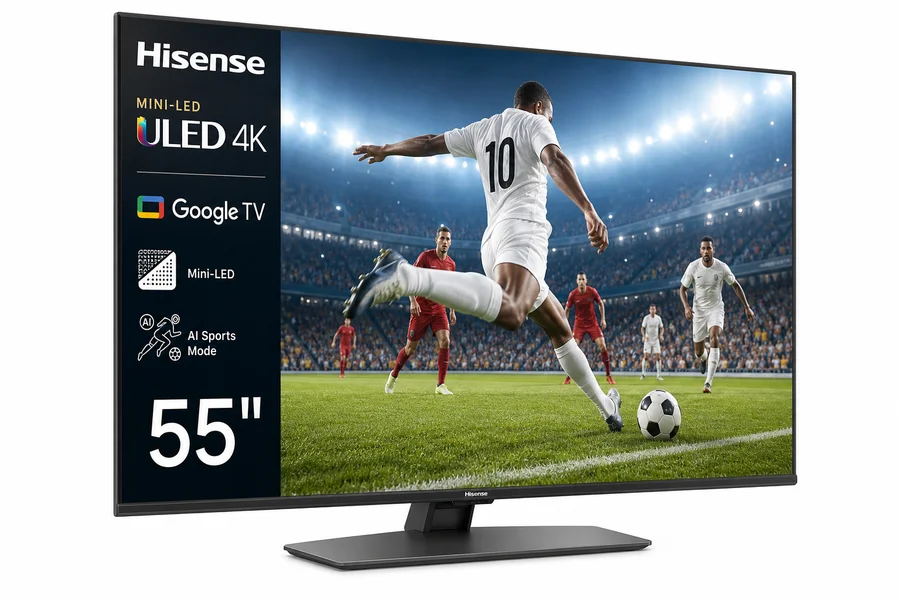
At the budget end, QLED wins: a Hisense U8N 55" Mini-LED delivers exceptional brightness for £649, while entry-level OLED at this size is rare. At the large screen end (75"+), QLED remains better value.
Our Verdict
Choose OLED if: you watch in a dark or moderately lit room, you're a gamer, you value cinema-quality pictures, or you simply want the best picture for your money under £1,500.
Choose QLED/Mini-LED if: your room is very bright, you need peak brightness for sports HDR, you want a large screen (75"+) for less money, or you prefer Samsung's ecosystem.
Choose QD-OLED if: you want the absolute best and budget isn't the primary concern — the Samsung S95D is the best TV we've reviewed in 2026.
Call us on 01543 505 062 — Mon–Sat 9am–6pm. Tell us your room, budget and what you mainly watch, and we'll give you a straight answer in two minutes.